
Local officials removed cameras, Flock re installed with no authority.
By Brian Kniveton
If you live in Grass Valley, you probably don’t spend much time thinking about surveillance cameras.
You go to work. You take your kids to school. You run errands. You drive to the grocery store, visit friends, go out to dinner, and come home. Like most people, you expect that when you go about your daily life, you aren’t being quietly tracked everywhere you drive.
That’s why what happened with the Flock cameras in Grass Valley should concern all of us.
The Grass Valley Police Department made the decision to stop using Flock license-plate cameras and began removing them. The department’s decision followed concerns about privacy, data collection, data retention, and how information gathered by these cameras could potentially be accessed or shared.
For many residents, that seemed like the end of the story.
It wasn’t.
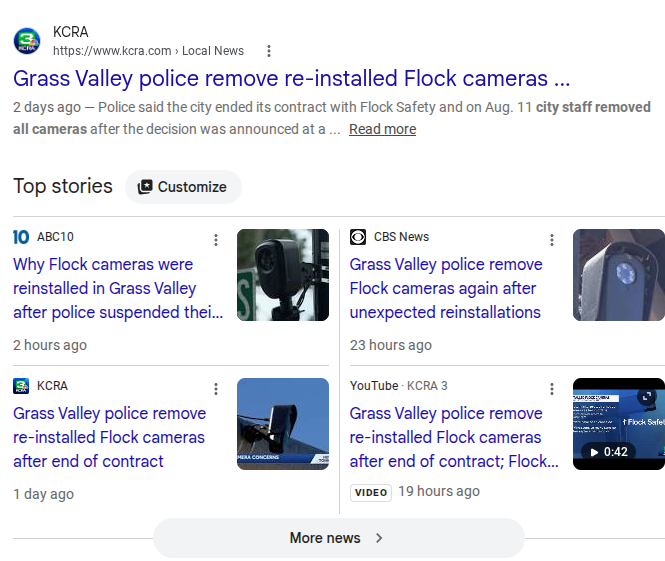
After the city had removed the cameras, some of them began showing up again.
Imagine that for a moment.
You are a homeowner or taxpayer in Grass Valley. Your local police department makes a decision to end a surveillance program. The cameras come down. Then you notice crews putting cameras back up.
Naturally, you might ask: Who authorized this? Why are they being put back? And who gave them permission?
Those are reasonable questions.
Flock Safety has said the cameras were reinstalled because an automated maintenance system mistakenly generated work orders after the cameras went offline. In other words, according to the company, this wasn’t an intentional attempt to ignore Grass Valley’s decision.
But from the perspective of an ordinary resident, that explanation doesn’t make the situation any less troubling.
Think about it this way: If a private company accidentally sent workers onto your property and installed equipment you had already told them you didn’t want, would you simply shrug your shoulders and say, “Well, their computer system made a mistake”?
Of course not.
You would expect someone to take responsibility.
This isn’t really about being for or against technology. It isn’t even about whether license-plate cameras can help police solve crimes. Those are separate questions.
The bigger question is who gets to decide whether we are being monitored?
Our community elected officials and public agencies are supposed to make those decisions transparently. Residents deserve to know what technology is being used, what information is being collected, how long it is kept, who can access it, and where that information can go.
And when a public agency says a surveillance program is over, residents should be able to trust that the program is actually over.
I’m not suggesting that every police officer or every Flock employee has bad intentions. Most people involved are simply doing their jobs.
But good intentions aren’t enough when technology can collect information about thousands of innocent people going about their everyday lives.
Grass Valley is our community. These are our streets. These are our families, businesses, neighborhoods, and homes.
That’s why I believe we should keep asking questions.
Not because we’re anti-police.
Not because we’re anti-technology.
Because we’re pro-community, pro-privacy, and pro-accountability.
When surveillance equipment comes down, it should stay down unless the people who represent this community make a clear and transparent decision to put it back.
That’s not asking too much.
That’s simply asking for accountability.
— Brian Kniveton